Replacing legacy systems with modern architecture and technology is often costly and time-consuming – especially when dealing with a low-code environment that lacks basic best practices like test automation or CI/CD.
The real challenge is gaining control over the existing solution. Documentation is usually missing, and there’s often no safe or controlled environment for making changes. This leads to a classic chicken-and-egg problem: you want to modernize to become more agile, but such a major transition feels nearly impossible without already being agile.
Navara has developed an approach that allows organizations to make the technology switch fully automated, creating a modern foundation where best practices can be applied. This enables further improvements to be made in a predictable and structured way.
To make this happen, Navara developed a new tooling that automatically validates whether the new implementation is functionally identical to the original, which is critical for keeping surrounding integrations intact.
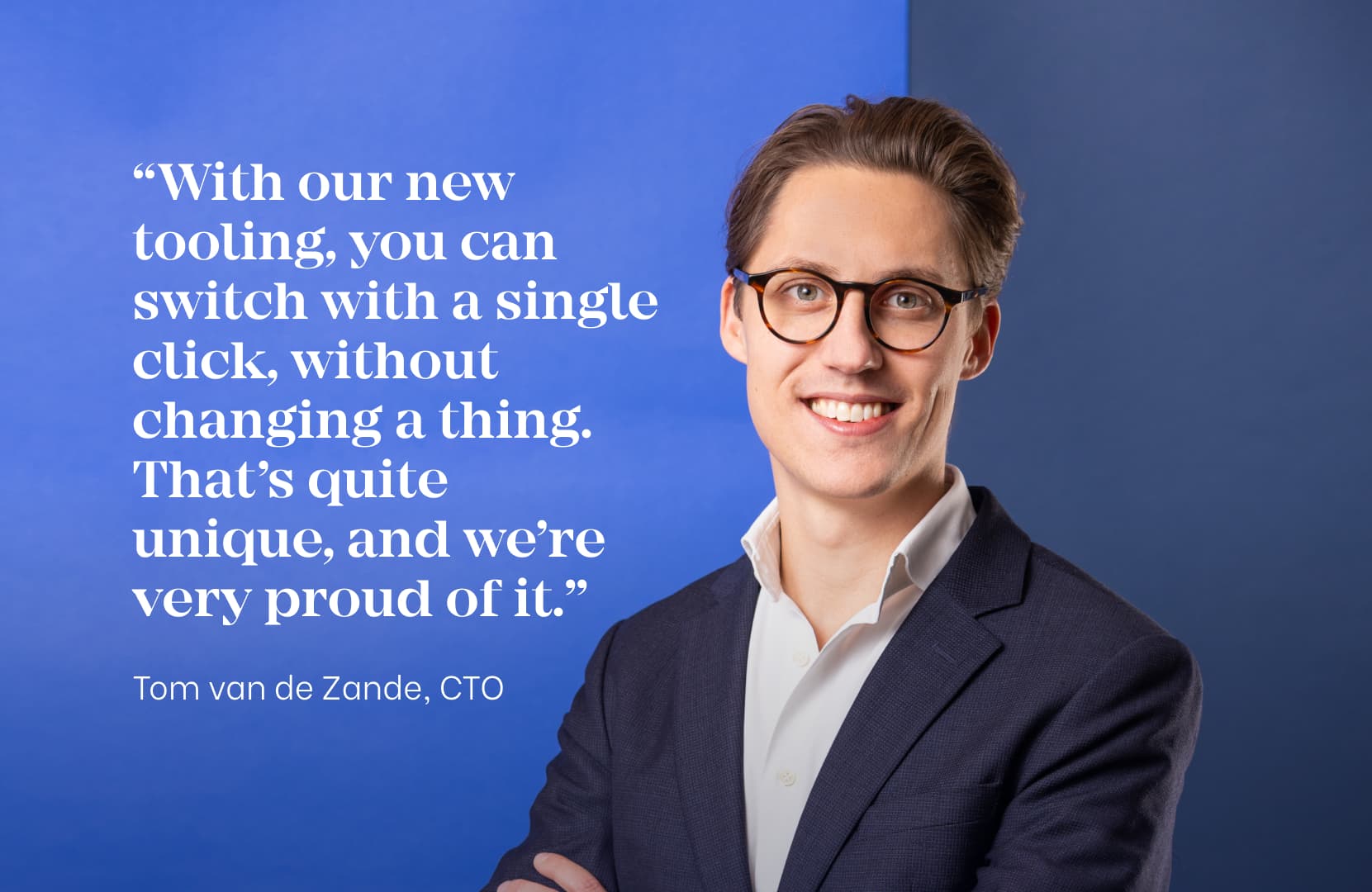
“It really saves a huge amount of time and resources. It works so well that we’re going to license it to interested parties,” says Navara CTO Tom van de Zande.
Why this tooling is so crucial? Well, Essent can attest to that. The TIBCO implementation was the main cause of a major national outage that generated a lot of negative publicity.
How this unique solution came about
“Never again” was Essent’s motto after several key IT systems failed in early September 2022 at the height of the (European) energy crisis. Essent partnered with Navara to replace TIBCO’s cumbersome, expensive low-code platform with a modern, future-proof, cloud-native stack.
And that change was long overdue. With an increasingly complex product portfolio, a fast-moving energy transition, and mounting geopolitical uncertainty, Essent needed to react faster to shifts in the market, or any other unexpected event.
The low-code hangover is severe
Essent is not alone. More and more organizations are rethinking their low-code implementations. The early promises simply aren’t holding up. When it comes to core IT systems, code consistently proves to be the superior solution. Essent’s case was no different.
Van de Zande: “Code enables best practices like version control, test automation and CI/CD. And that’s just a few. Many of these practices are either not possible or only partially supported in low-code platforms. Yet they are essential to keep IT complexity manageable and to ensure you can keep innovating in a safe and controlled way.”
“The first part of the project was completed in April of this year,” Van de Zande adds. “We replaced a complex TIBCO BusinessWorks integration landscape with a microservices architecture in an AWS/TypeScript stack.””
For the second part of the project, which involved converting business processes from TIBCO ActiveMatrix BPM, Navara developed a unique tool that performs a single technology conversion.
More certainty
Van de Zande: “Just over a year ago, we came into contact with Temporal. They developed a framework that allows you to model business processes directly in code. This gives you access to all the proven software engineering best practices, while also offering scalability and resilience. And because it’s open source, you avoid vendor lock-in.”
“You know what the problem is with low-code platforms? You never really know where you stand. Will the platform continue to be supported? What happens to licensing? As soon as your entire business depends on it, you’re basically stuck. With a modern, code-first technology like Temporal, you’re more flexible, future-proof and you save significantly on costs.”
“The core of our approach is this: first, we handle the technology transition. Then we implement best practices. Only after that do we start modernising. That’s how we maintain full control and predictability, while also minimising the dual phase. That’s what we call the period where old and new technologies are running side by side. The complexity of that phase is consistently underestimated and it’s the main reason so many migrations fail.”
“If you really want to switch technologies with a single push of a button, then everything needs to behave exactly the same. Only then can you isolate the change. That’s what we’ve built tooling and a working method for. It’s quite unique and we’re proud of it.” says Van de Zande with a smile.